DSP processing plugin. More...
#include <src/plugins/plugin.h>
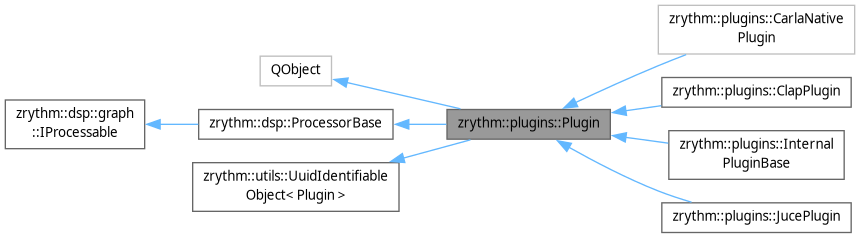
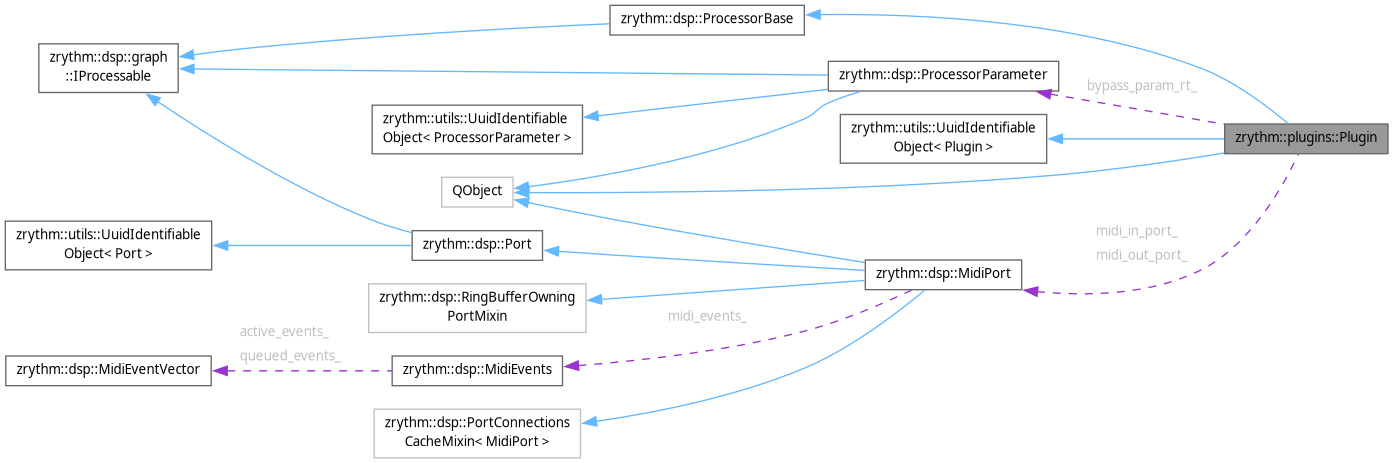
Data Structures | |
| struct | ParamSync |
| Per-parameter state for bidirectional plugin sync. More... | |
Public Types | |
| enum class | InstantiationStatus : std::uint8_t { Pending , Successful , Failed } |
| Public Types inherited from zrythm::utils::UuidIdentifiableObject< Plugin > | |
| using | uuid_base_type |
| Exposes the CRTP parameter for concept checking. | |
Public Member Functions | |
| int | programIndex () const |
| Returns the current program index, or -1 if no program exists. | |
| void | setProgramIndex (int index) |
| Q_SIGNAL void | programIndexChanged (int index) |
| Implementations should attach to this and set the program. | |
| PluginConfiguration * | configuration () const |
| Q_SIGNAL void | configurationChanged (PluginConfiguration *configuration, bool generateNewPluginPortsAndParams) |
| Emitted when the configuration is set on the plugin. | |
| dsp::ProcessorParameter * | bypassParameter () const |
| dsp::ProcessorParameter * | gainParameter () const |
| bool | uiVisible () const |
| void | setUiVisible (bool visible) |
| Q_SIGNAL void | uiVisibleChanged (bool visible) |
| Implementations should listen to this and show/hide the plugin UI accordingly. | |
| InstantiationStatus | instantiationStatus () const |
| Q_SIGNAL void | instantiationStatusChanged (InstantiationStatus status) |
| Q_SIGNAL void | instantiationFinished (bool successful, const QString &error) |
| To be emitted by implementations when instantiation finished. | |
| PluginDescriptor & | get_descriptor () const |
| utils::Utf8String | get_name () const |
| Protocol::ProtocolType | get_protocol () const |
| void | set_configuration (const PluginConfiguration &setting) |
| Sets the plugin configuration to use. | |
| void | custom_prepare_for_processing (const dsp::graph::GraphNode *node, units::sample_rate_t sample_rate, units::sample_u32_t max_block_length) final |
| void | custom_process_block (dsp::graph::ProcessBlockInfo time_nfo, const dsp::ITransport &transport, const dsp::TempoMap &tempo_map) noexcept final |
| Custom processor logic after processing all owned parameters. | |
| void | custom_release_resources () final |
| bool | currently_enabled () const |
| Returns whether the plugin is enabled (not bypassed). | |
| bool | currently_enabled_rt () const noexcept |
| std::string | save_state () const |
| Serializes the plugin's internal state to a base64-encoded string. | |
| void | load_state (const std::string &base64_state) |
| Queues a previously saved state to be applied to the plugin. | |
| void | flush_plugin_values () |
| Flushes plugin-reported parameter values to Zrythm params. | |
| Public Member Functions inherited from zrythm::utils::UuidIdentifiableObject< Plugin > | |
| UuidIdentifiableObject (QObject *parent=nullptr) | |
| auto | get_uuid () const |
| Public Member Functions inherited from zrythm::utils::UuidIdentifiableBase | |
| UuidIdentifiableBase (QObject *parent=nullptr) | |
| UuidIdentifiableBase (const QUuid &id, QObject *parent=nullptr) | |
| QUuid | raw_uuid () const |
| Public Member Functions inherited from zrythm::dsp::ProcessorBase | |
| ProcessorBase (utils::IObjectRegistry ®istry, utils::Utf8String name={ u8"ProcessorBase" }) | |
| void | set_name (const utils::Utf8String &name) |
| Set a custom name to be used in the DSP graph. | |
| void | add_input_port (const dsp::PortUuidReference &uuid) |
| void | add_output_port (const dsp::PortUuidReference &uuid) |
| void | add_parameter (const dsp::ProcessorParameterUuidReference &uuid) |
| auto & | get_input_ports () const |
| auto & | get_output_ports () const |
| auto & | get_parameters () const |
| const ParameterChangeTracker & | change_tracker () const noexcept |
| Returns the change tracker. | |
| utils::Utf8String | get_node_name () const final |
| Returns a human friendly name of the node. | |
| void | process_block (dsp::graph::ProcessBlockInfo time_nfo, const dsp::ITransport &transport, const dsp::TempoMap &tempo_map) noexcept final |
| Calls custom_process_block() internally after processing all the parameters. | |
| void | prepare_for_processing_impl (const graph::GraphNode *node, units::sample_rate_t sample_rate, units::sample_u32_t max_block_length) final |
| void | release_resources () final |
| Called to release resources allocated by prepare_for_processing(). | |
| Public Member Functions inherited from zrythm::dsp::graph::IProcessable | |
| virtual units::sample_u32_t | get_single_playback_latency () const |
| Returns the latency of only the given processable, without adding the previous/next latencies (zero latency by default). | |
| void | prepare_for_processing (const GraphNode *node, units::sample_rate_t sample_rate, units::sample_u32_t max_block_length) |
| Called to allocate resources required for processing. | |
Protected Member Functions | |
| Plugin (utils::IObjectRegistry ®istry, QObject *parent) | |
| Creates/initializes a plugin and its internal plugin (LV2, etc.) using the given setting. | |
| dsp::ProcessorParameterUuidReference | generate_default_bypass_param () const |
| To be called by implementations to generate the default bypass parameter if the plugin does not provide its own. | |
| dsp::ProcessorParameterUuidReference | generate_default_gain_param () const |
| To be called by implementations to generate the default gain parameter if the plugin does not provide its own. | |
| Protected Member Functions inherited from zrythm::utils::UuidIdentifiableBase | |
| void | set_raw_uuid (const QUuid &id) |
| Protected Member Functions inherited from zrythm::dsp::ProcessorBase | |
| auto | registry () const -> utils::IObjectRegistry & |
Protected Attributes | |
| bool | instantiation_failed_ = false |
| Set to true if instantiation failed and the plugin will be treated as disabled. | |
| std::optional< dsp::ProcessorParameter::Uuid > | bypass_id_ |
| Bypass toggle parameter,. | |
| std::optional< dsp::ProcessorParameter::Uuid > | gain_id_ |
| Zrythm-provided plugin gain parameter. | |
| std::vector< dsp::AudioPort * > | audio_in_ports_ |
| std::vector< dsp::AudioPort * > | audio_out_ports_ |
| std::vector< dsp::CVPort * > | cv_in_ports_ |
| dsp::MidiPort * | midi_in_port_ {} |
| dsp::MidiPort * | midi_out_port_ {} |
| dsp::ProcessorParameter * | bypass_param_rt_ {} |
| ParamSync | param_sync_ |
Friends | |
| void | to_json (nlohmann::json &j, const Plugin &p) |
| void | from_json (const nlohmann::json &j, Plugin &p) |
Detailed Description
DSP processing plugin.
Can be external or internal.
Plugin State Persistence
All plugin types serialize their state as base64-encoded data within the project JSON file via their to_json/from_json functions. There are no separate state files on disk — JSON serialization is the sole persistence mechanism.
Each plugin subclass includes a "state" key in its to_json() output containing the base64-encoded plugin state. During from_json(), the state is deserialized first and stored in a temporary member (e.g., state_to_apply_), then applied after the plugin instance is fully initialized. No filesystem paths or state directories are involved.
Member Enumeration Documentation
◆ InstantiationStatus
|
strong |
Constructor & Destructor Documentation
◆ Plugin()
|
protected |
Creates/initializes a plugin and its internal plugin (LV2, etc.) using the given setting.
- Exceptions
-
ZrythmException If the plugin could not be created.
Member Function Documentation
◆ configuration()
|
inline |
◆ configurationChanged()
| Q_SIGNAL void zrythm::plugins::Plugin::configurationChanged | ( | PluginConfiguration * | configuration, |
| bool | generateNewPluginPortsAndParams ) |
Emitted when the configuration is set on the plugin.
Implementing plugins should attach to this and, if generateNewPluginPortsAndParams is true, query the underlying plugin for its port/parameter layout and create corresponding Zrythm objects. If false, ports and parameters already exist (e.g., after JSON deserialization) and only the underlying plugin instance needs to be reinitialized.
- Parameters
-
configuration The plugin configuration. generateNewPluginPortsAndParams Whether the handler should create new Zrythm ports and parameters from the underlying plugin.
◆ currently_enabled()
|
inline |
◆ currently_enabled_rt()
|
inlinenoexcept |
◆ custom_prepare_for_processing()
|
finalvirtual |
Reimplemented from zrythm::dsp::ProcessorBase.
◆ custom_process_block()
|
finalvirtualnoexcept |
Custom processor logic after processing all owned parameters.
By default, this does passthrough to same-type ports.
Reimplemented from zrythm::dsp::ProcessorBase.
◆ custom_release_resources()
|
finalvirtual |
Reimplemented from zrythm::dsp::ProcessorBase.
◆ flush_plugin_values()
| void zrythm::plugins::Plugin::flush_plugin_values | ( | ) |
Flushes plugin-reported parameter values to Zrythm params.
Called on the main thread by a timer (~20ms). Exchanges pending_value atomics and calls setBaseValue() for any non-sentinel values.
◆ get_descriptor()
|
inline |
◆ get_name()
|
inline |
◆ get_protocol()
|
inline |
◆ instantiationFinished()
| Q_SIGNAL void zrythm::plugins::Plugin::instantiationFinished | ( | bool | successful, |
| const QString & | error ) |
To be emitted by implementations when instantiation finished.
This is used since some plugins do instantiation asynchronously. The project should re-calculate the DSP graph when this gets fired.
- Parameters
-
error Non-empty on instantiation failure.
◆ instantiationStatus()
|
inline |
◆ load_state()
| void zrythm::plugins::Plugin::load_state | ( | const std::string & | base64_state | ) |
Queues a previously saved state to be applied to the plugin.
The state will be applied during the next processing cycle.
◆ programIndex()
|
inline |
◆ save_state()
| std::string zrythm::plugins::Plugin::save_state | ( | ) | const |
Serializes the plugin's internal state to a base64-encoded string.
- Returns
- Base64-encoded state, or empty string if no state is available.
◆ set_configuration()
| void zrythm::plugins::Plugin::set_configuration | ( | const PluginConfiguration & | setting | ) |
Sets the plugin configuration to use.
This must be called exactly once right after construction to set the PluginConfiguration for this plugin.
When called during fresh construction, the plugin will have no ports or parameters and the signal will instruct handlers to create them. When called during deserialization (after ports/params are already restored from JSON), the signal will instruct handlers to skip creation and only reinitialize the underlying plugin instance.
◆ setProgramIndex()
|
inline |
◆ setUiVisible()
|
inline |
◆ uiVisible()
Field Documentation
◆ audio_in_ports_
|
protected |
◆ audio_out_ports_
|
protected |
◆ bypass_id_
|
protected |
◆ bypass_param_rt_
|
protected |
◆ cv_in_ports_
|
protected |
◆ gain_id_
|
protected |
◆ instantiation_failed_
|
protected |
◆ midi_in_port_
|
protected |
◆ midi_out_port_
|
protected |
◆ param_sync_
Property Documentation
◆ bypassParameter
|
read |
◆ configuration
|
read |
◆ gainParameter
|
read |
◆ instantiationStatus
|
read |
◆ programIndex
◆ uiVisible
The documentation for this class was generated from the following file:
- src/plugins/plugin.h